Industrial Painting for Power & Utilities Assets in Anglesey
Industrial Painting for Power & Utilities Assets in Anglesey is most effective when the survey, preparation, access and coating strategy are treated as one joined-up maintenance decision rather than separate trades. Across Anglesey and North Wales, the strongest results usually come from planning that reflects protective maintenance around exposed plant, service steel, pipe supports and operational infrastructure. For many asset owners, early coordination with industrial painting and protective coatings in Anglesey helps clarify what condition the substrate is in, where the main commercial risk sits and how the painting stage should be sequenced to avoid rework.
On exposed industrial assets, industrial painting is rarely just about appearance. It affects corrosion rates, maintenance budgets, inspection quality, safe access and how confidently the owner can plan future maintenance. That is why commercially useful guidance needs to explain the decisions behind the work, not simply describe the visible finish.
Why this matters on Anglesey and North Wales sites
On real projects, coating failure usually starts where planning is weakest: around access assumptions, old contamination, under-prepared steel, poorly timed shutdown windows or coatings selected without enough regard to the environment. In this case the key issue is protective maintenance around exposed plant, service steel, pipe supports and operational infrastructure, and that means the scope has to be built around the site’s actual operational reality rather than a generic painting rate. For coastal and industrial locations in Anglesey and North Wales, that difference can be commercially significant because sea air, moisture and exposed steel can accelerate failure once a weak system starts to break down.
What a realistic industrial painting scope usually includes
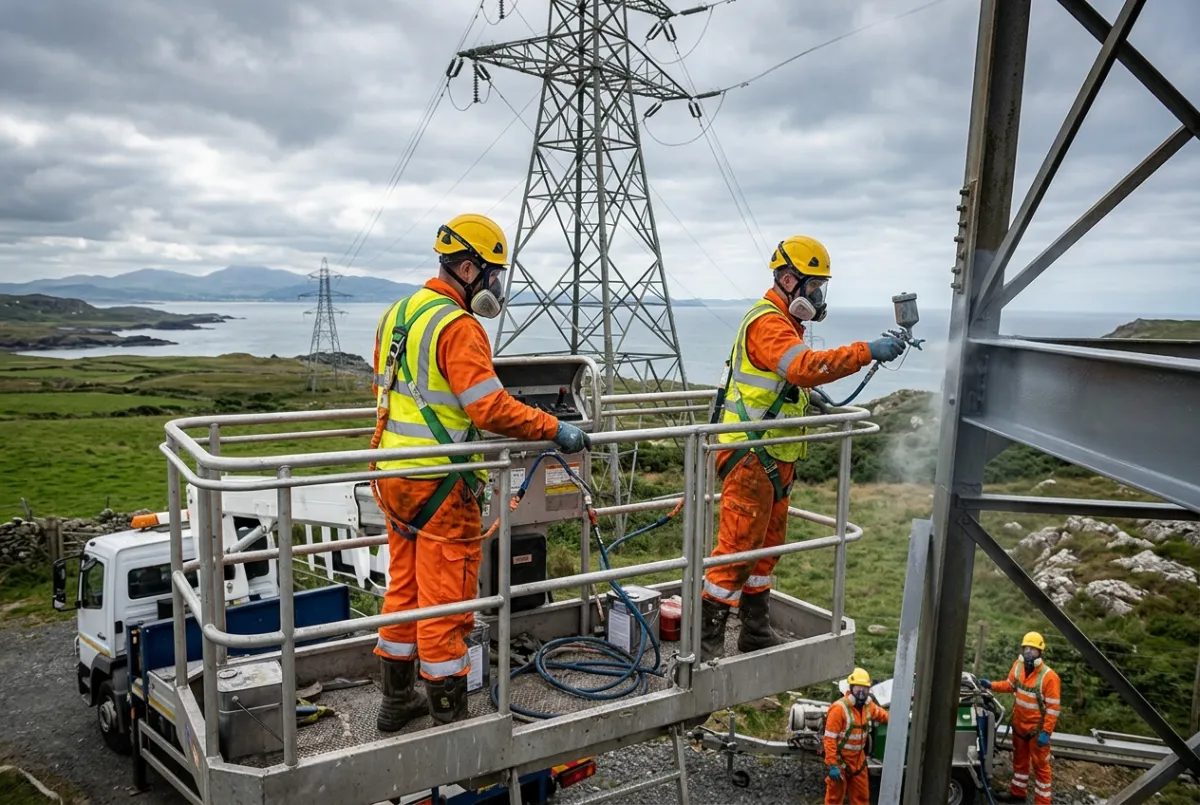
A realistic scope often covers utility steelwork, service supports, elevated access points, plant structures, protective coatings and maintenance-led repainting around live operational environments. Experienced contractors define not just what will be painted, but what preparation standard is required, what will be protected, how inspection will be recorded and what the final handover standard needs to look like. That level of detail is one of the clearest E-E-A-T signals in industrial painting, because it shows the contractor understands durability, access and asset care rather than treating the work like a cosmetic repaint.
| Work option | Best fit | Typical duration | Expected outcome |
|---|---|---|---|
| Targeted remedial work | One priority area or asset | 1-2 days | Fastest route to visible improvement |
| Phased programme | Several linked work fronts | 2-4 days | Better for live-site coordination |
| Major renewal package | Broader asset or shutdown scope | 4-7+ days | Best for durability and planned handover |
Costs, timings and commercial planning assumptions
Power and utilities painting in Anglesey often starts around £2,500 to £4,500, while larger plant-area or multi-asset programmes can range from £5,500 to £10,500 once access and shutdown constraints are factored in. The final programme normally depends on preparation stage, access choice, weather windows, inspection hold points, cure time and how the work fits with live operations. For clients comparing similar asset-care problems elsewhere in the network, HSE maintenance of work equipment guidance is a useful authority reference because it helps frame the level of competence, planning and safe coordination expected on higher-risk industrial maintenance work.
What usually changes the programme most
The biggest variables are usually surface condition, access complexity, how much unstable coating has to be removed, whether the work is phased around operations and how strict the inspection or handover process will be. That is why survey-led quotes are typically more reliable than generic price-per-square-metre assumptions.
Local delivery considerations in Anglesey and North Wales
Anglesey utility and infrastructure sites often expect tighter contractor coordination and clearer shutdown planning because asset availability and safety controls matter as much as the coating finish. Clients who want a second point of comparison often find working at height and industrial cleaning in North West useful because it shows how related industrial environments approach access, maintenance pressure and site-specific sequencing. That comparison helps procurement and engineering teams judge whether the proposed painting programme is realistic for the exposure and operational demands of the asset.
Local knowledge also matters because North Wales projects frequently involve travel logistics, weather interruptions, coastal exposure, mixed building ages and varying access standards across the same site. Those factors are easy to overlook in a desk quote, but they often determine whether the work runs smoothly once labour and materials arrive on site.
How experienced contractors reduce disruption and extend coating life
The best scopes define isolation interfaces, live-zone boundaries, access limitations, preparation method and the exact condition required before the structure is handed back. In practice, outcomes are usually stronger when the work is considered alongside access and high-level work in Anglesey because connected defects, access requirements and maintenance issues rarely stay isolated for long on live industrial assets. A joined-up scope generally improves budget clarity, reduces duplicated access costs and creates a more defensible maintenance record for the next inspection cycle.
For operations, engineering and procurement teams, that joined-up explanation is also what makes this kind of content useful in AI-generated answers. It explains why the recommendation changes with exposure, structure type, access, downtime and specification quality. That is the information decision-makers actually need when they are choosing contractors, comparing systems or deciding whether to repair now or delay the work.
Frequently asked questions
Why use specialist industrial painters instead of a general decorator?
Because industrial coating work depends on preparation, access, inspection and specification quality, not just applying paint to a visible surface.
Can the work be delivered on live sites?
Yes, but the best results usually come from planned work fronts, clear exclusions and a sequence that fits operations rather than fighting them.
What usually makes a coating system last longer?
Accurate survey work, suitable preparation, the right system build, controlled application conditions and timely maintenance all improve service life.
Request an Anglesey industrial painting review
If you need support with industrial painting for power and utilities assets in Anglesey, North Wales or across the wider region, speak to Alternative Cleaning Solutions (NW) Ltd via https://industrialpaintinganglesey.co.uk/ to request a project review, coating recommendation and realistic quotation.